
For over 50 years, we have dedicated ourselves to providing Industry with best in class wire management solutions and to helping solve mission critical issues.

The needs of today’s schools and universities are changing fast. When it comes to anticipating and meeting those needs, MonoSystems is in a class of its own.

For the past five decades, we’ve made it our business to offer more value to our partners, which in turn provides greater value to their customers.
Choosing the right Ro Booster Pump can shape reverse osmosis performance. It can help maintain stable pressure, consistent flow, and dependable water production. In homes, offices, and small commercial systems, demand changes throughout the day. A quiet pump may fill a storage tank smoothly. A poorly matched model may create vibration, leaks, or disappointing output. The pump must work with inlet pressure, membrane capacity, tubing size, power supply, and daily water usage.
These seven tips reflect checks commonly used by experienced technicians and installers. Flow rate matters, but pressure range, automatic controls, motor durability, and energy use also deserve attention. A pump designed for a laboratory system may be excessive for a kitchen unit. An undersized model may run continuously and wear faster. Check the manufacturer’s performance curve, not only its advertised pressure rating. That detail is often overlooked. Confirm compatibility with the membrane, transformer, switches, fittings, and available cabinet space. A reliable supplier should provide clear specifications, installation guidance, warranty terms, and responsive technical support.
Real conditions can reveal weaknesses that product pages hide. Hard water, voltage fluctuations, limited space, and irregular maintenance can affect pump performance. Listen for unusual vibration during operation. Inspect connections for dampness. Record pressure before and after installation. Small observations matter. No selection method is perfect, and careful advice can still miss a site-specific problem. A pump that performs well in one building may not suit another. Comparing verified specifications, operating conditions, and long-term support offers a more dependable path than choosing by price or appearance alone.
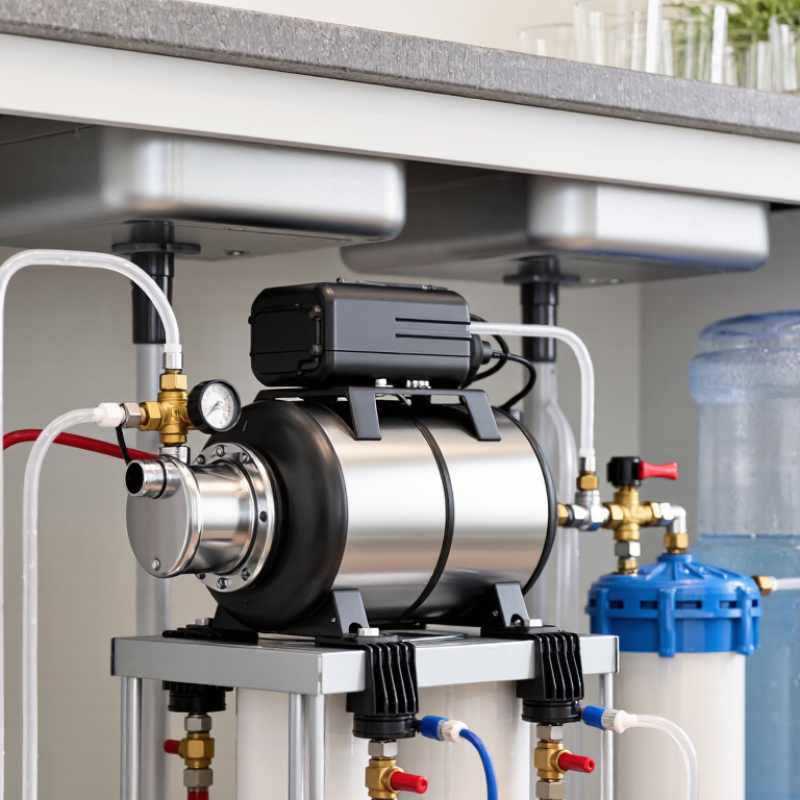
An RO booster pump raises feed-water pressure before water reaches the membrane. This pressure helps the membrane separate dissolved salts, metals, and other unwanted substances. Without enough pressure, production slows, rejection performance may fall, and wastewater can increase. In field checks, I measure pressure while the system is running. Static readings can be misleading. A pump that sounds quiet at startup may become harsh under continuous load.
Choose a pump by required flow, working pressure, and water temperature, not by size alone. Check the membrane’s rated pressure before increasing output. Excess pressure can damage housings, seals, or fittings. Confirm that the pump suits the feed-water quality and electrical supply. A prefilter matters too. Sediment can restrict the inlet and make the pump work harder. I also prefer pressure-switch and dry-run protection, plus an accessible shutoff valve. These features reduce risk when a supply tank empties or a filter blocks.
Noise, vibration, and frequent cycling deserve attention during installation. Flexible connections can reduce vibration, but they cannot correct poor alignment. Leave space for filter changes and inspect leaks after several hours of operation. Keep a simple record of inlet pressure, outlet pressure, flow, and membrane age. Pressure tells the story. That record can reveal gradual performance loss. My early pump selections were sometimes oversized. More power was not always better. A correctly matched pump supports stable pressure and predictable water output.
7 Tips for Choosing the Right RO Booster Pump
Measure pressure at the faucet, not only at the main supply line. Static pressure can look healthy while flow pressure collapses. WQA technical guidance places many residential RO systems near 40–100 psi, depending on membrane design. Check the pressure while water is running. Record gallons per minute from the actual inlet line. Then match the pump’s rated flow, pressure, and duty cycle. A pump showing impressive free-flow numbers may perform poorly through clogged filters.
Account for water temperature, total dissolved solids, and elevation. Cold water reduces membrane production, sometimes noticeably during winter. The U.S. EPA WaterSense guidance reports that conventional RO systems may waste about three gallons for every gallon produced. Efficient operation therefore requires correct pressure, not simply a larger pump. Inspect pressure loss across sediment and carbon filters. A 10-psi drop deserves attention. Confirm the membrane’s maximum pressure before selecting the pump. Use a pressure switch that responds to tank filling and automatic shutoff. Keep electrical protection suitable for wet locations.
Field technicians often discover that the pump is not the real problem. A restricted valve or undersized tube can imitate weak pumping. One imperfect assumption remains common: rated flow is not delivered flow. Test the system after installation. Compare inlet pressure, permeate flow, and reject flow with the membrane data sheet. If the readings disagree, pause before increasing pressure. Higher pressure can worsen leaks, noise, or membrane damage.
| Tip | Assessment Dimension | Typical Requirement or Reference Value | How to Check | Selection Guidance |
|---|---|---|---|---|
| 1. Measure the Incoming Water Pressure | Static and dynamic inlet pressure | Many residential RO membranes operate most effectively at approximately 60–100 psi (4.1–6.9 bar), subject to the membrane manufacturer’s specification. | Install a pressure gauge before the RO system and measure pressure with no water demand and while the system is producing water. | Choose a pump that raises pressure into the membrane’s recommended operating range without exceeding the system’s maximum rated pressure. |
| 2. Match the Required Flow Rate | Permeate, feed, and concentrate flow | A typical residential RO membrane may be rated from about 50 to 100 gallons per day, equivalent to approximately 0.035–0.070 gallons per minute of permeate under specified test conditions. | Check the membrane capacity, storage-tank refill time, faucet demand, and any appliance demand connected to the system. | Select a pump with sufficient rated flow at the required pressure; do not compare pumps by maximum flow alone. |
| 3. Calculate the Required Pressure Increase | Pressure differential, or boost requirement | Required boost pressure = Target membrane pressure − Minimum dynamic inlet pressure. | Example: if the target is 80 psi and the measured dynamic inlet pressure is 35 psi, the theoretical boost requirement is approximately 45 psi before accounting for losses. | Allow for pressure losses through prefilters, tubing, valves, fittings, and flow restrictors when sizing the pump. |
| 4. Account for Water Quality and Temperature | Total dissolved solids, temperature, and fouling potential | Reverse osmosis output decreases as feedwater temperature falls. Membrane ratings are commonly based on standardized test conditions near 77°F (25°C), with specific correction factors required for colder water. | Record feedwater temperature and TDS, and review hardness, iron, chlorine, and sediment levels that may affect pretreatment and membrane life. | Do not use higher pump pressure to compensate for inadequate pretreatment; protect the membrane with correctly maintained filters. |
| 5. Verify Electrical and Control Requirements | Voltage, current, duty cycle, and automatic controls | Common residential pump systems use low-voltage DC power supplied through a compatible transformer, while some commercial systems use AC power. The exact voltage and current must match the equipment rating. | Confirm the available electrical supply, transformer output, pump current draw, and compatibility with low-pressure and high-pressure shutoff controls. | Use electrical protection and controls rated for the installation. The pump should stop when the storage tank is full or the feedwater supply is interrupted. |
| 6. Check Compatibility with the RO System | Membrane size, tubing, fittings, flow restrictor, and tank configuration | Small residential systems commonly use 1/4-inch or 3/8-inch tubing, but connection sizes and components vary by system design. | Compare pump inlet and outlet connections, tubing size, membrane housing, flow restrictor, check valve, and automatic shutoff arrangement. | Select a pump designed for the system’s membrane capacity and plumbing configuration; use appropriate adapters only when they maintain a secure, leak-free connection. |
| 7. Evaluate Efficiency, Noise, and Maintenance | Energy use, operating noise, heat, service life, and maintenance access | A suitable pump should provide the required pressure and flow without continuous over-pumping, excessive vibration, or operation outside its rated duty cycle. | Review rated power consumption, duty-cycle limits, sound specifications if available, installation orientation, and replacement-part availability. | Prefer a correctly sized, automatically controlled pump with accessible filters, stable mounting, and adequate ventilation. |
Note: Pressure, flow, membrane capacity, electrical ratings, and connection sizes vary by RO system. Always confirm the pump and membrane specifications before installation.
Choosing the right RO booster pump starts with the membrane’s real operating point, not the pump’s maximum rating. Check required feed pressure, flow rate, inlet pressure, and daily operating hours. A pump rated at 100 psi may deliver far less at the required flow. That mismatch can cause low recovery, noisy operation, or premature membrane fouling. The U.S. Department of Energy recommends evaluating pumps at their duty point, where flow and pressure work together efficiently.
Feed-water quality also changes the specification. Higher TDS creates greater osmotic pressure and may require additional feed pressure. The World Health Organization’s Guidelines for Drinking-water Quality classify TDS below 600 mg/L as generally good for taste, while higher levels may become less acceptable. Taste is not the only concern. Temperature, hardness, iron, and suspended solids affect membrane loading and pump selection. A practical design should include a pressure gauge before the membrane, a flow meter, and a reliable low-pressure shutoff.
Electrical compatibility matters. Confirm voltage, frequency, motor protection, and duty cycle before installation. The International Energy Agency reports that electric motor systems consume about 53% of global electricity, so poor sizing can quietly increase operating costs. Select corrosion-resistant wetted materials, especially where feed water contains salts. Variable-speed control can help stabilize pressure, but it adds complexity and requires correct programming. Bigger is not always better. In field commissioning, installers sometimes chase pressure and overlook flow balance. That mistake deserves a second look.
Choose materials that match the water chemistry. 316 stainless steel resists corrosion better in demanding systems. Reinforced polymer may reduce weight, but ultraviolet exposure and chemical compatibility require checking. Match seals with cleaning agents and operating temperatures. Do not trust appearance alone. A cheaper housing can become an expensive replacement.
Read the pump curve at the actual flow and pressure. The U.S. Department of Energy identifies pumping systems as roughly 25% of industrial electricity use. Oversizing increases throttling losses and operating costs. The IEA’s Energy Efficiency 2023 report also highlights motor-driven systems as a major global electricity load. Select a high-efficiency motor and consider variable-speed control. Measure watts under real demand.
Noise matters. Short bursts are different from a constant hum. Specify measured sound levels using ISO 3744 methods, not vague “quiet” claims. Ask for installation data near the membrane. At home, sound travels through pipes.
Protect the pump against dry running, overheating, and unstable inlet pressure. These safeguards support reliability, but they cannot fix poor installation. Hydraulic Institute guidance emphasizes correct sizing, alignment, and operating conditions for pump performance. Inspect connections, vibration, and pressure readings during maintenance. Keep a simple service log. It reveals gradual decline before failure. One assumption may still be wrong: laboratory efficiency rarely equals field efficiency. Real water temperature, fouling, and voltage change the result.
7 Tips for Choosing the Right RO Booster Pump
Tip 1: Check your installation space before buying. Measure the cabinet, pipe distance, and power outlet. A compact pump may still need room for servicing. Tip 2: Match the pump with your system’s required flow and pressure. Excessive pressure can damage membranes and fittings. Tip 3: Confirm electrical compatibility and grounding. Do not rely on adapters without checking their safety rating.
Tip 4: Study maintenance access carefully. Filters, seals, and connections should be easy to reach. Tip 5: Choose a pump with clear service instructions and replaceable wear parts. Cheap components may increase future labor costs. Keep records. They reveal pressure changes before failure becomes obvious. In my experience, neglected connections often create more trouble than the pump itself.
Tip 6: Compare long-term value, not only the purchase price. Consider energy use, noise, expected service life, and replacement costs. A quieter pump matters in a kitchen installed beside a bedroom. Tip 7: Ask whether the pump includes useful protection, such as dry-run control or automatic shutoff. These features can prevent avoidable damage. Still, no protection system replaces proper installation. I have seen well-designed equipment perform poorly because tubing was bent too sharply. Leave space for improvement.
Practical benchmarks for installation, maintenance, performance, and long-term value
Residential reverse osmosis systems commonly perform best when membrane feed pressure is maintained near 60–80 psi. A booster pump should match the system voltage, flow requirement, automatic shut-off controls, and available installation space. Regular filter replacement, leak checks, and pump inspection help protect membrane performance and extend service life.